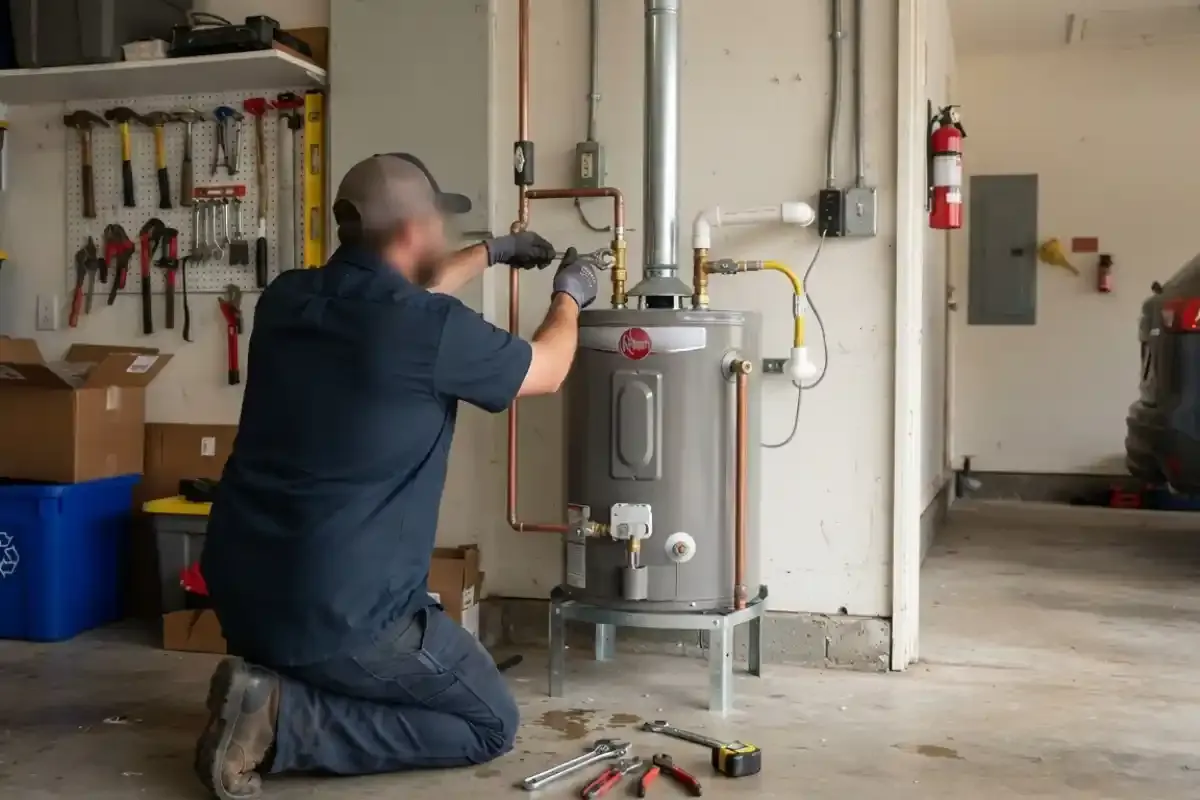
Power Vent Water Heater Installation in Syracuse, UT
A power vent heater solves the problem of a short or awkward flue run, and it asks more of the installer than a standard tank. Here is what the job involves.
What a power vent water heater is
A power vent water heater is a gas tank unit with a fan that pushes exhaust out through a plastic vent pipe. A standard atmospheric heater relies on a hot flue to rise through a metal vent to the roof. The fan frees the installer to run the vent through a sidewall, which helps when the roof route is long, blocked or not allowed.
That flexibility costs you something. The fan needs a 120-volt outlet, the unit makes some fan noise and a failed fan or pressure switch takes the heater down. If your utility room has no outlet nearby, the job grows by an electrical step.
Four reasons homeowners choose power vent
No roof route
A finished ceiling or a long run to the roof makes a sidewall vent simpler.
Tight utility room
Some power vent units pull combustion air from the room or from outside, which matters in a closed closet.
Replacing a tank in a new layout
A moved heater location can still reach a sidewall.
Efficiency goals
Power vent units can run more efficiently than atmospheric tanks, and ratings vary by model.
If none of those fits your house, a standard tank may be the simpler choice. Our water heater installation page explains how we choose.
The parts of a power vent installation
Gas line
Correct size and a shutoff within reach, with a drip leg and a leak test.
Vent run
Plastic vent pipe with the slope, support and termination distances the manufacturer requires.
Power
A 120-volt outlet or a hardwired connection for the fan and controls.
Water side
Shutoffs, flex lines, an expansion tank where needed and a relief valve with a discharge pipe.
Each part has a failure point. A badly sloped vent collects condensate, a wrong gas size starves the burner and a missing discharge pipe turns a relief event into a flood.
Want a plumber to check your utility room?
Call to book a visit. We will look at vent routes, power and gas before quoting.
Power vent versus a standard tank
| Question | Power vent | Standard tank |
|---|---|---|
| Vent route | Sidewall or roof, plastic pipe | Metal vent up through the roof. |
| Needs electricity | Yes, for the fan | No. |
| Works in a power outage | No | Often yes. |
| Noise | Fan noise | Quiet. |
| Placement flexibility | Higher | Lower. |
The power outage row matters in winter. A gas tank with a standing pilot keeps heating when the grid is down. A power vent unit stops with the fan. If hot water during an outage matters to you, say so when you plan.
Check the license and ask about the permit
Gas water heater work belongs with a licensed plumber. The Utah Division of Occupational and Professional Licensing has a Verify a License tool at secure.utah.gov/llv/search/index.html, and plumbing license types include apprentice, journeyman, residential journeyman, master and residential master. Check the name on the license before anyone starts.
Syracuse City Code does not adopt a plumbing code as a whole, so ask Syracuse City Public Works at 801.825.7235 which permits and inspections apply to your address. If a gas smell ever appears, leave the building, then call 911 and Enbridge Gas at 1-800-767-1689 first.
Source type: State licensing database and city code
Replacing versus installing new
If your old heater has failed and you want a power vent unit, the job is a replacement with extra venting and power steps. See water heater replacement for what that visit covers. For a new location, the same steps apply, plus a drain and sometimes a new gas line.
If you live in Layton, the same rules apply, and plumbers dispatch from Syracuse. See plumbing in Layton for ZIP codes and local notes.
Prepare the utility room
- Clear a three-foot path to the heater and the work area.
- Know where the main water and gas shutoffs are.
- Plan for water to be off for part of the day.
- Move stored items away from the old heater.
A clear room speeds the job and keeps the work safe around gas and hot water.
Care for a power vent unit after it is in
Power vent heaters need the same yearly attention as any tank, plus a look at the fan and the vent. Listen for a change in fan noise, check the vent pipe for sagging or loose joints and make sure the air intake is clear of dust and lint.
Flush a few gallons from the tank drain each year to clear sediment, and test the relief valve with a plumber's guidance. A heater with a logged service history is easier to diagnose and easier to sell with the house.
Vent clearances are not optional
Utah's state construction code amends the International Plumbing Code (IPC) for use statewide, under Utah Code Title 15A, Chapter 3, Part 3. Power vent terminations have required distances from windows, doors and air intakes, and the manufacturer's manual adds its own.
A plumber who measures those clearances before drilling the wall saves you from moving a vent later.
What to do if something smells wrong after the install
- If you smell gas, leave the building, then call 911 and Enbridge Gas at 1-800-767-1689 first. Do not use switches or phones inside.
- If a carbon monoxide alarm sounds, get everyone outside into fresh air and call 911.
- If the fan stops or the vent pipe separates, shut off the heater and call the plumber who installed it.
- When to call us: any vent noise, soot, or a heater that shuts off repeatedly.
Power vent water heater questions
No. The fan needs power, so the heater stops when the electricity goes out. A standard gas tank with a pilot can keep heating, which is worth weighing if outages concern you.
Gas, venting and combustion air are safety-critical, and a mistake can cause carbon monoxide or fire. Hire a licensed plumber and ask what permits apply.
Plan on most of a day for a straight swap and longer if the vent or power must be added. The plumber confirms the timeline after seeing the room.
No. A sidewall vent is the point of a power vent system, provided clearances from windows and openings are met.
Often yes on a closed system. The plumber checks your pressure and tells you.
Plumbing help that matches this guide
We cover Syracuse and nearby towns on one number. See the full service area list or call (385) 488-1892 any hour.