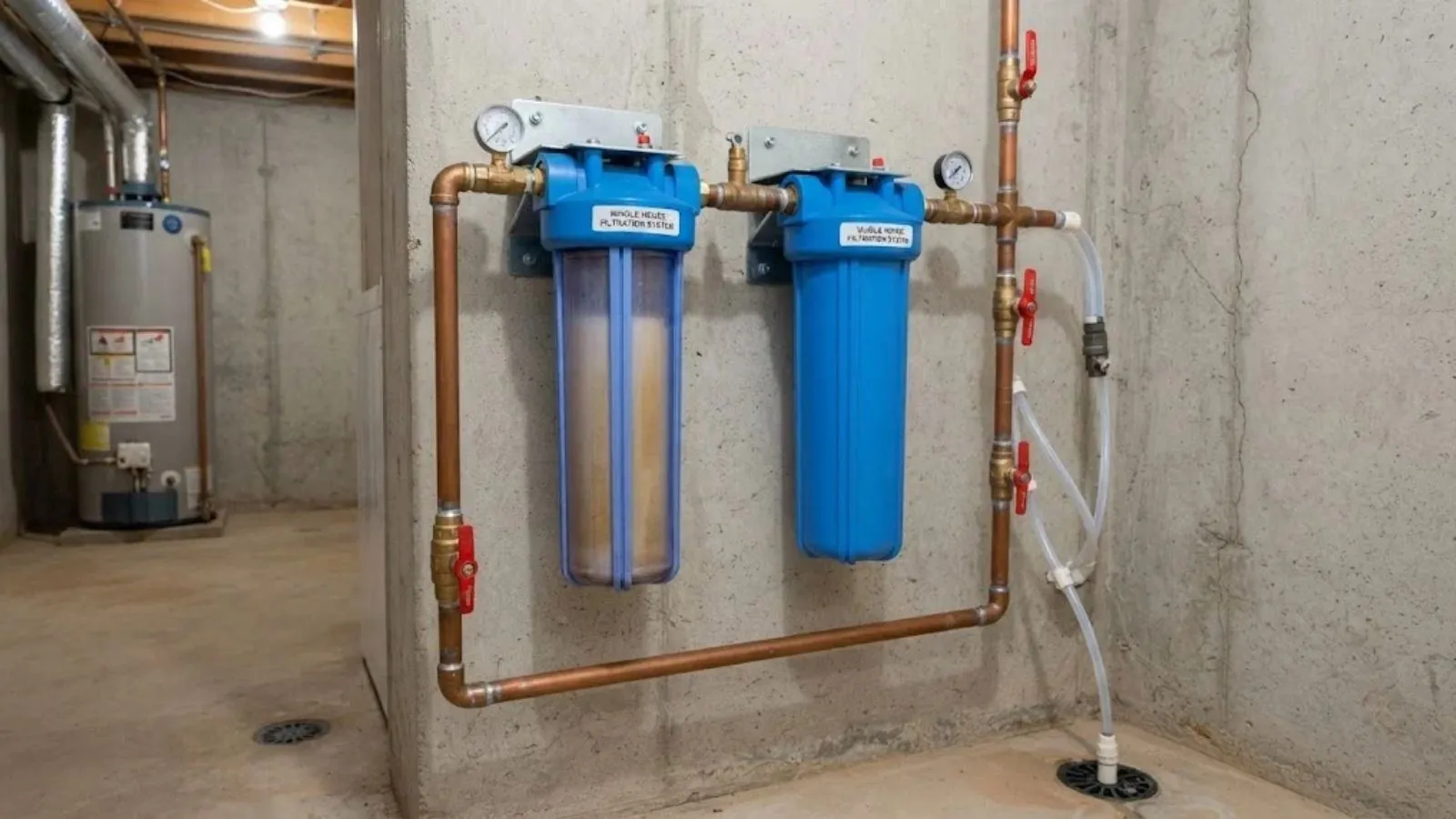
Sand Water Filtration Systems for Syracuse, UT Homes
A sand or media filter catches grit, and it does not soften water or remove everything. Here is what it does, what it cannot, and how to decide if you need one.
How a sand filter works
A sand or media filter is a tank of graded sand or similar material that traps particles as water flows through. Over time the bed fills with what it catches, so the unit is backwashed, which reverses the flow and flushes the debris to a drain.
It is good at removing grit, silt and other suspended particles. It is not a softener and it does not remove dissolved minerals, bacteria or most chemicals.
Match the filter to the problem
| Problem | Sand or media filter helps? | Better tool |
|---|---|---|
| Grit or silt in the water | Yes | Sand or media filter. |
| Hard water scale | No | Water softener. |
| Chlorine taste and smell | No | Carbon filter. |
| Rust particles | Often | Sediment filter or media. |
| Bacteria | No | Disinfection, tested by a lab. |
If your water is clear and spots only on glass, a sand filter will not help. Spend on a test first.
Not sure what you need?
Call. We test and explain, without selling a system you do not need.
Culinary water and secondary water are not the same
Syracuse culinary water comes from city Well #3 and water purchased from Weber Basin, with a 3-million-gallon tank built in 2021. That water is already treated and delivered, so most households do not need a sand filter on it. Test your tap before spending anything.
Secondary water is different. It is diverted from the Weber River through canals to city ponds and then pressurized for irrigation, and it can carry silt and debris. Utah law requires secondary water meters by 2030. A sand or media filter on the irrigation side protects sprinkler heads and drip lines, and it does not belong on the line that feeds the kitchen.
Source type: City water documents and state statute
What to settle before buying
Our plumbing installation page explains how we plan new equipment into an existing system.
If hardness is the real problem
If your trouble is scale on fixtures and in the water heater, a water softener is the tool, not a sand filter. The two can work together, with the filter catching grit ahead of the softener.
If you live in Layton, the same questions apply. Layton gets water from city wells, Weber Basin and a secondary system, and plumbers dispatch from Syracuse. See plumbing in Layton.
How a backwash cycle works
Stop service
The valve diverts the flow and isolates the bed.
Reverse flow
Water flows upward and lifts the bed, releasing trapped debris.
Rinse
A short downward rinse resettles the bed.
Return to service
The valve returns to filtering and the cycle ends.
The wastewater needs a drain that can take it, and it is not a good idea to dump it where it could wash silt toward a neighbor or a storm drain.
What a sand filter will not do
A sand filter will not make water safe to drink, remove lead or soften it. If you have a health concern about your water, a lab test is the right step, and the lab can tell you which treatment, if any, fits.
Do not rely on a filter for a private source that has not been tested. Syracuse homes use city water, so that is rarely the case here, though a few rural properties nearby have other sources.
How to size a media filter
Size depends on the flow you need at peak, usually measured in gallons per minute, and on the amount of sediment. A house with several bathrooms and irrigation draws more than a small home. A plumber measures the line, checks the pressure and picks a unit that meets the flow without choking it.
What to do before you open a filter tank
- Close the inlet and outlet valves, and open the bypass before opening the tank.
- Relieve the pressure with the vent or a nearby faucet. A tank under pressure can spray.
- Never open the head or the valve while water is flowing.
- Wear gloves and eye protection when handling media or chemicals.
- Call a licensed plumber if a valve will not close or the tank leaks.
Sand filter questions
Most do not for drinking water. Test your tap, and consider a filter if you see grit or silt, or for irrigation lines.
No. It removes particles, not dissolved hardness.
On a schedule the maker sets, and more often if the water carries a lot of silt.
Yes, on the irrigation side. Keep it off the culinary line.
Several years in many units. Follow the maker's guidance.
Plumbing help that matches this guide
We cover Syracuse and nearby towns on one number. See the full service area list or call (385) 488-1892 any hour.